Three things changed in 2025 and 2026. The federal tax credits for rooftop solar, batteries and efficiency upgrades ended, so a family moving into a new home in 2026 cannot claim them. New central air conditioners switched to lower impact refrigerants, which pushed equipment prices up. And energy codes now differ more from city to city. What lowers a Valley electric bill has not changed: a tight, well insulated envelope, shade, and air conditioning sized to the house.
This is general information, not tax advice. Talk to a tax professional about your own return.
Which federal energy credits ended?
The July 2025 federal budget law ended three credits that touched new homes, according to the IRS:
| Credit | What it covered | When it ended |
|---|---|---|
| Residential clean energy credit, section 25D | Rooftop solar, battery storage, geothermal | No credit for expenditures made after December 31, 2025 |
| Energy efficient home improvement credit, section 25C | Efficiency upgrades to an existing home | No credit for property placed in service after December 31, 2025 |
| New energy efficient home credit, section 45L | A credit builders claimed on efficient new homes | No credit for homes acquired after June 30, 2026 |
The detail that matters for a new build: for solar installed on a newly built home, the IRS treats the expense as made when you first begin using the home. So a family moving in during 2026 does not qualify for the solar credit, even if the panels were paid for in 2025.
Separately, a 2024 rule that required new homes financed with FHA or USDA loans to meet the 2021 international energy code was rescinded effective May 1, 2026, after a federal court in Texas vacated it (Federal Register).
Why do new air conditioners cost more?
Under the federal AIM Act, the EPA restricted the refrigerants allowed in new air conditioning systems. Since January 1, 2025, new split systems have to use refrigerants below a global warming potential limit of 700, and installing new systems with R410A equipment made or imported after that date remains prohibited, the EPA explains. Manufacturers moved to R454B and R32.
The switch was fast: those lower impact systems made up 91% of distributor sales by September 2025, HARDI reported. It was not smooth: the EPA itself noted shortages, price spikes and stockpiling of R454B in 2025. Manufacturers had told the trade press to expect base equipment prices roughly 10% higher.
For a new home the practical effect is simple: your system is designed around the new refrigerant from the start, with no retrofit questions later. Just make sure whoever services it is trained on the new refrigerants.
What efficiency is the legal minimum?
Since January 1, 2023, a new split central air conditioner installed in Texas, which the Department of Energy places in its hot and humid Southeast region, must reach at least 14.3 SEER2 below 45,000 Btu per hour and 13.8 SEER2 above it (DOE). On the old scale, 14.3 SEER2 is about 15 SEER.
Our standard is at least 15 SEER, sized to the house rather than to the nearest round number, with higher efficiency equipment available as an upgrade. The rating is only half of it. An oversized unit cools the air quickly, shuts off before it removes the humidity, and leaves a Valley house feeling clammy at 74°F. Correct sizing is what makes the rating pay off.
Which energy code applies to my house?
It depends on where the lot sits:
| Location | Energy code in force |
|---|---|
| Unincorporated county land | The state minimum: the energy chapter of the 2015 International Residential Code, adopted by the State Energy Conservation Office in 2016 (Texas Comptroller) |
| City of McAllen | The 2024 international codes, including the residential and energy codes, in effect since January 1, 2026 with local amendments, as reported |
| City of Edinburg | The 2018 international codes, including the residential and energy codes (City of Edinburg) |
| Other Valley cities | Whatever the city has adopted; the building department confirms it |
Outside city limits, Texas law lets the builder show energy code compliance through an accredited program, a certified inspection or the builder’s own certification, and requires the builder to keep the records for three years and give the owner a copy. Either way, the code is a floor. Every home we build meets or exceeds the current Texas energy code.
What actually lowers a Valley electric bill?
- The envelope. Open cell spray foam insulation throughout, air sealing at every penetration and an attic radiant barrier come standard on every home we build.
- The windows. Low E double pane windows, and less glass facing west. ENERGY STAR windows are wanted by 83% of buyers in NAHB’s latest survey of buyer preferences, and in this climate the orientation of that glass matters as much as its rating.
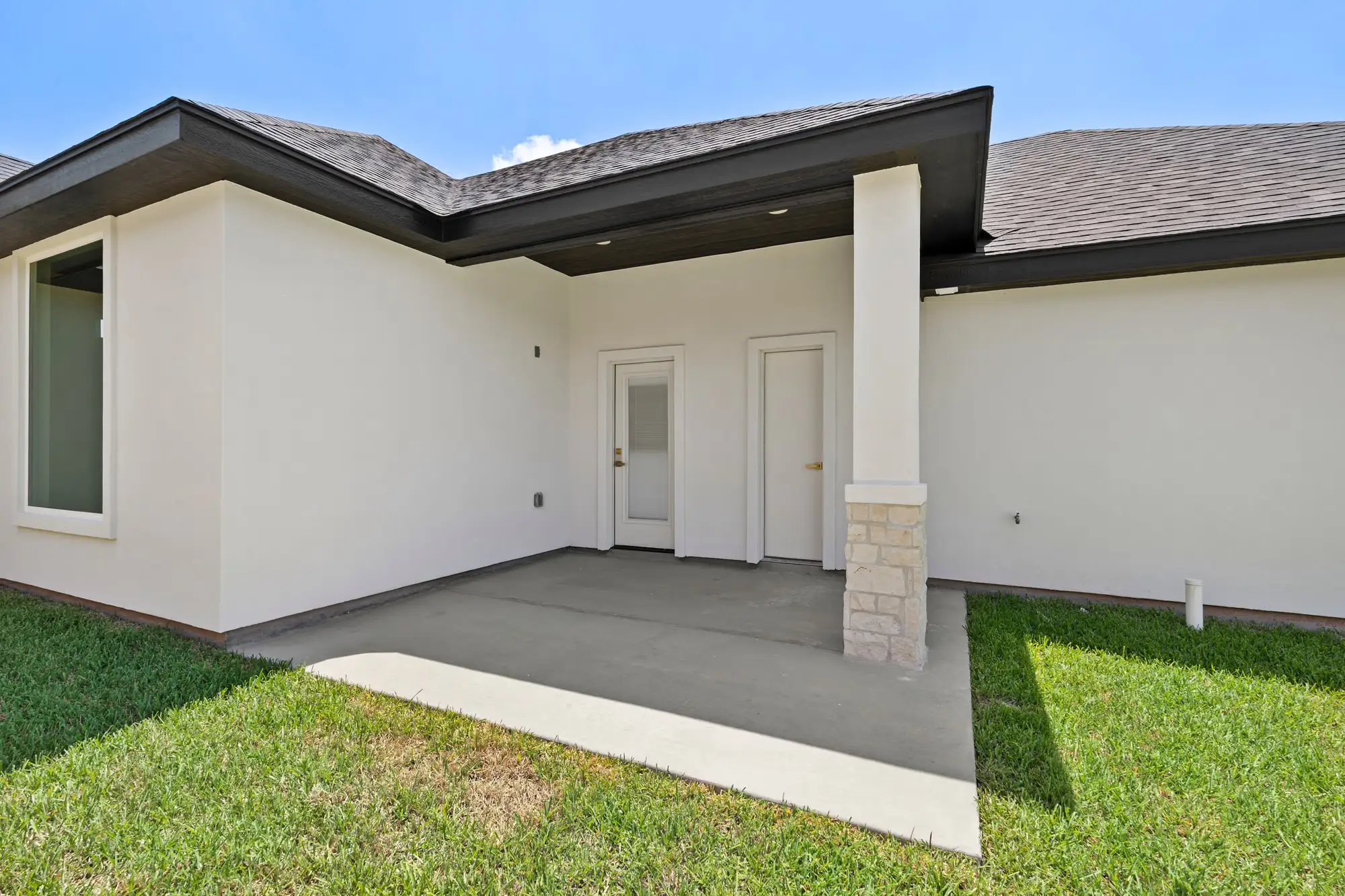
- Shade. Deep covered porches and patios on the south and west, placed where the afternoon sun actually lands on your lot.
- The right size air conditioning, with ducts sealed and a programmable thermostat.
- Hot water. A tankless water heater is an available upgrade.
Details are on our construction standards page. None of these depend on a tax credit, and they keep working for as long as you live in the house.
Is solar still worth considering without the credit?
It can be, but the math now rests on your bill savings alone. The answer depends on your usage, your roof’s orientation and your electricity plan. Where retail choice applies, the price you get for power you send back to the grid depends on the provider and plan you choose; municipal utilities and cooperatives set their own rules.
The low cost move is to decide later without paying twice: solar conduit pre wiring is an available upgrade, so panels can be added later without opening finished walls. If backup power matters to you, plan the electrical panel space and a transfer switch location during design, when it costs the least.
Frequently asked questions
Can I still get a federal tax credit for solar on my new home?
Not the residential clean energy credit if you begin using the home in 2026 or later, because for new construction the IRS treats the expense as made at move in. Ask your utility about local programs, and a tax professional about your situation.
What refrigerant will my new air conditioner use?
A lower impact refrigerant, typically R454B or R32, as required for new systems since the 2025 EPA transition.
Is spray foam worth it in South Texas?
We think so, which is why it is in every contract rather than on an options sheet. It seals the gaps that let hot, humid air into the house, and in a climate where summer regularly passes 100°F, that shows up on every bill.
Does a higher SEER unit pay for itself?
Sometimes. It depends on how much you run it, what you pay for electricity and the price difference between units. Ask for the comparison in writing, and do not let a higher rating stand in for correct sizing.
Planning a new home? Our custom home design team builds shade, orientation and window placement into the plan from the first sketch, and you can schedule a consultation to start yours.