Start with your lot’s FEMA flood zone. In a high risk zone, marked A or AE on the map, the house needs a floodplain permit, an elevation certificate and a finished floor high enough to meet local rules, and a federally backed mortgage will require flood insurance. Outside those zones, slab height and grading still decide whether water stays out: the March 2025 storm damaged more than 5,000 structures across the Valley.
A flood zone does not make a lot unbuildable. It changes the order of the work: the pad height gets settled before the floor plan does.
How do I find my lot’s flood zone?
Enter the address on the FEMA Flood Map Service Center. The map shows the zone and, in AE zones, the base flood elevation: the height floodwater is expected to reach in a flood with a 1% chance of happening in any given year.
| Zone | What it means for a new home |
|---|---|
| X (unshaded) | Minimal mapped risk. No federal insurance requirement, but grading still matters. |
| X (shaded) | Moderate risk, between the 1% and 0.2% annual chance floodplains. Insurance optional and worth pricing. |
| A | High risk, no base flood elevation published. An engineer or surveyor may need to establish one. |
| AE | High risk with a published base flood elevation. Floodplain permit, elevation certificate and required insurance with a federally backed loan. |
Check the map’s age too. FEMA’s October 2025 inventory lists the effective flood maps for McAllen from 1982 and for Edinburg and unincorporated Hidalgo County from 2000, while Cameron County’s date from 2018 and Starr County’s from 2010 (FEMA). No new preliminary maps were listed for either Valley county. Individual map panels can carry different dates, and a map drawn decades ago does not know about the subdivisions, streets and drains built since, which is why we look at the ground itself and not only the map.
What did the March 2025 floods show?
From the evening of March 26 to the early morning of March 28, 2025, between 8 and more than 19 inches of rain fell across the Valley. Harlingen measured 15.18 inches over three days, McAllen 9.13, Weslaco 8.60 and Brownsville 6.74. The National Weather Service in Brownsville rated it an event with a 1 in 100 to 1 in 200 annual probability, 1 in 500 in a few areas, and counted more than 5,000 structures affected, more than 2,000 of them with major damage or destroyed. Cameron, Hidalgo, Starr and Willacy counties received a federal major disaster declaration in May 2025.
Two lessons carry straight into how a house should sit on its lot:
- Height relative to the street matters as much as the map. In a storm like that, streets become channels, and a floor that sits well above the street’s centerline stays dry far more often than one that sits level with it.
- Drainage capacity is being built, but it takes years. Hidalgo County Drainage District No. 1 is working through the projects in its 2023 bond, and the North Main Drain serving McAllen and Edinburg was placed on the Texas Water Development Board’s flood funding list in 2025 (HCDD1). Build for the drainage that exists today.
How high does the slab need to be?
In unincorporated Hidalgo County, the county’s subdivision rules require the finished floor to sit at least 18 inches above the centerline of the street the lot faces, or 18 inches above natural ground, whichever is higher, and require an elevation certificate for every lot inside a designated flood zone. Cities set their own requirements inside their limits, and in a mapped high risk zone the floor must meet the base flood elevation plus whatever freeboard the local ordinance adds.
Freeboard is height above the minimum. FEMA encourages communities to require at least one foot of it and notes that freeboard results in significantly lower flood insurance rates. It is one of the few extra costs in a build that pays you back every year.
How the height gets built:
- An engineered pad. Select fill, placed and compacted in layers, then the post tension slab engineered to your soil report on top.
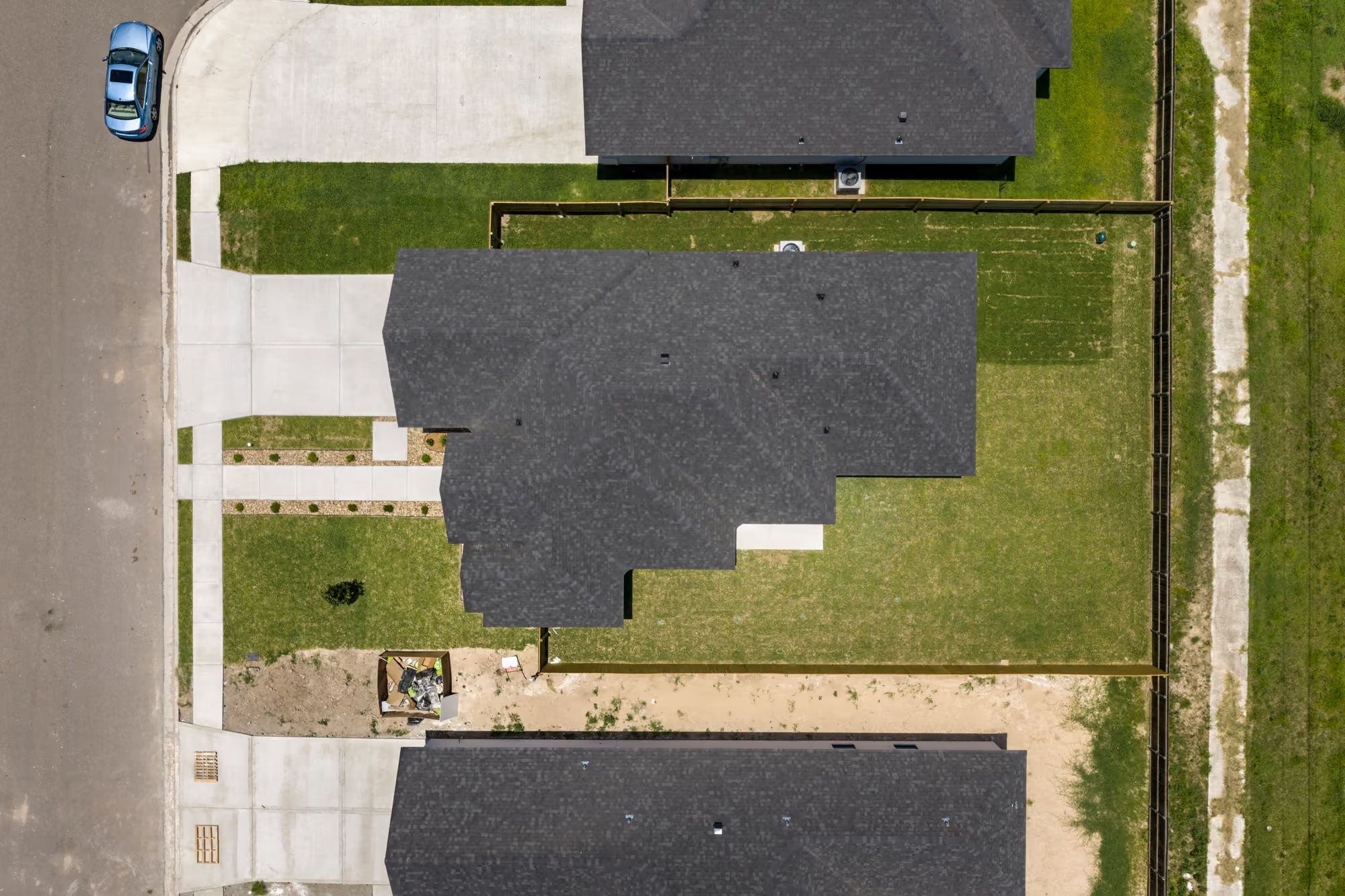
- Grading. The lot slopes away from the house on every side, with swales that carry water to the street or the drainage easement, not to the neighbor.
- Driveway and entry. A higher pad means a longer driveway slope and sometimes an extra step at the entry, which is easier to design in than to fix.
Do I need flood insurance?
- Required: if the home is in a high risk zone, A or AE, and your mortgage is federally backed or regulated, flood insurance is mandatory.
- Not covered elsewhere: standard homeowners policies do not cover flood damage.
- Priced by your home’s risk: the National Flood Insurance Program prices policies under Risk Rating 2.0, fully in effect since April 2023. An elevation certificate is optional for pricing but can lower your rate.
- Mind the waiting period: a new flood policy typically takes 30 days to go into effect, except when it is bought in connection with a mortgage. If you are building outside a high risk zone and want coverage, buy it before you need it.
- Watch the authorization date: Congress most recently extended the program’s authorization to December 11, 2026 (FEMA). If it lapses, new program policies cannot be issued, so a closing that needs one should line up private flood coverage as a backup.
What does a flood zone add to the budget?
| Item | Who handles it |
|---|---|
| Fill beyond the ten dirt hauls in our contract | Quoted after the site evaluation |
| Survey and elevation certificate | Licensed surveyor, coordinated by us |
| Floodplain development permit | Filed with the city or county with your building permit |
| Flood insurance | Your agent or lender; quoted before closing |
We price site work after walking the lot, not from an average. The 2026 cost guide shows what the base contract includes.
What do we check before you buy or design?
- The FEMA zone and, where published, the base flood elevation.
- The street centerline elevation compared with natural ground at the house location.
- Where water goes today: ditches, drains, easements and low spots on and around the lot.
- What neighbors saw in March 2025, which is often better data than the map.
- The finished floor height your jurisdiction requires, and how much fill it takes to get there.
- A flood insurance quote, even where it is optional.
Frequently asked questions
Can I build in a floodway?
Rarely in practice. Floodways carry the main flow of floodwater, and development there is allowed only when an engineering analysis shows it will not raise flood levels. Most homesites that touch a floodway put the house on the part of the parcel outside it.
Does building higher lower my flood insurance?
Generally, yes. Each foot of freeboard above the base flood elevation lowers flood risk, and FEMA notes that it results in significantly lower rates. An elevation certificate is how you prove the height.
My lot is in Zone X. Am I safe?
Lower risk is not no risk. Floodwater does not stop at a line on a map, and the March 2025 storm was rarer than the 1% annual chance flood the high risk zones are drawn for. The same basics apply: build the floor well above the street, grade away from the house, and price optional flood coverage.
Do you handle the flood paperwork?
Yes. We coordinate the survey, the elevation certificate and the floodplain permit with your building permit. Your part is choosing the insurance.
Thinking about a specific lot? Our site evaluation is free, and our guide to buying land to build in the Valley covers the rest of what to check before you sign. When you are ready, schedule a consultation.